



A major new data centre is proposed for 44–76 Simcock Avenue, Spotswood, with the Victorian Government currently assessing Planning Application PA2604553 through its Development Facilitation Program. GreenSquare DC says its MEL1 campus is designed for up to 240MW of IT capacity, making this a significant piece of long-term infrastructure for Melbourne’s west.
The debate around data centres is often reduced to whether people like them or not. That misses the larger issue.
Love them or hate them, data centres are becoming an integral part of modern society. Banking, healthcare, education, communications, government services, cloud computing and artificial intelligence all depend on increasingly large amounts of digital infrastructure.
The better question is not simply whether we build them. It is how we plan them, where we locate them, and whether we make full use of the energy and infrastructure that comes with them.
Data centres use large amounts of electricity, much of which ultimately leaves servers as heat. That heat must then be removed through cooling systems.
If we treat the facility only as an isolated industrial development, much of that energy may simply be rejected to the environment. If we plan at a precinct level, however, that heat can potentially become a useful resource.
European case studies already demonstrate this approach. At Val d’Europe in France, waste heat from a data centre is connected to a district-heating network serving an aquatic centre and business park. The system has approximately 7.8MW of thermal capacity.
That is why the Spotswood proposal deserves broader thinking than the boundaries of one property.
Waste heat could potentially support aquatic or hydrotherapy facilities, commercial hot-water users, industrial processes, food production, controlled-environment agriculture, thermal storage or future district-heating systems.
Not every option will prove viable. Temperature, distance, cooling technology, infrastructure costs and patterns of demand all matter. But these questions are cheapest and easiest to investigate before a site is built, not a decade later.
Even if there is no immediate customer for recovered heat, the development could potentially be designed to be “heat-recovery ready”, with provision for heat exchangers, pipe connections, easements or future infrastructure.
There is another particularly interesting feature of this location: Scienceworks is just down the road in Spotswood.
A major data centre incorporating real-world examples of energy recovery, efficient cooling and circular-economy thinking could become an extraordinary educational resource.
Scienceworks already provides school programs covering electricity, technology, engineering and climate-related topics. Imagine being able to show students how computing generates heat, how that heat can be captured, and how engineering can turn otherwise wasted energy into something useful.
The precinct could go further by including provision for a research and demonstration centre involving local universities. Researchers and students could test agricultural, environmental and engineering ideas in real-world conditions, including greenhouse agriculture, aquaculture, thermal storage, water systems and other emerging uses for recovered heat.
That would turn the area into a living laboratory rather than simply another industrial development.
The economic opportunity may be even larger.
Rather than seeing a data centre only as a very large electricity consumer, planning authorities could consider whether it could become an anchor around which complementary businesses develop. Access to a stable source of recoverable thermal energy may be valuable to businesses that would otherwise need to purchase gas or electricity to produce the same heat.
That requires a more holistic approach to land-use and infrastructure planning. Energy networks, digital infrastructure, industrial land, education, research, community facilities and future development should not always be planned in separate silos.
GreenSquare says it is consulting with the Spotswood community and that feedback will inform development of the proposal where practical. The company also says the facility is designed around a low-water, closed-loop hybrid cooling system and intends to support renewable-energy procurement.
That makes this an ideal time to ask another question: what happens to the heat?
This is not an argument against the project. It is an argument for extracting more value from infrastructure that, if approved, could operate in Spotswood for decades.
Large, strategically located industrial sites close to electricity infrastructure, transport, businesses and established communities are increasingly difficult to find.
We should seize this opportunity while we can.
Once these sites are developed, opportunities to integrate neighbouring uses can become much harder and more expensive to create.
Victoria has an opportunity to move beyond assessing data centres solely by what happens inside their fence line.
The Spotswood development could demonstrate a more integrated model—one that considers not only how much energy a data centre consumes, but where that energy ultimately goes and what additional economic, educational, research and community value can be created from it.
If even part of that otherwise wasted energy can support local businesses, research, education, community infrastructure or future development, surely that is an opportunity worth investigating before the concrete is poured.
David Curtano
“ Plan for progress, not just permission “
Spotswood Data Centre Offers a Chance to Think Bigger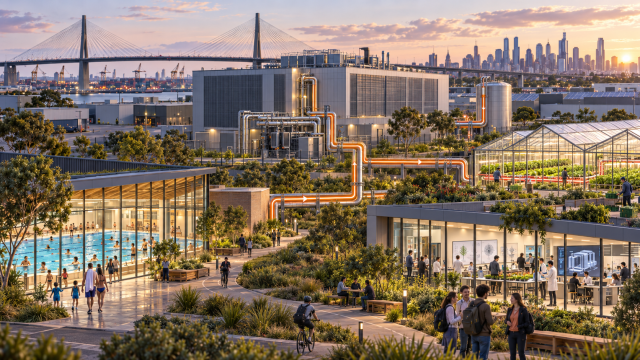
Welcome Visitor 8
To distribute this article more widely To manage this article or write your own article simply LOGIN
| ||||
